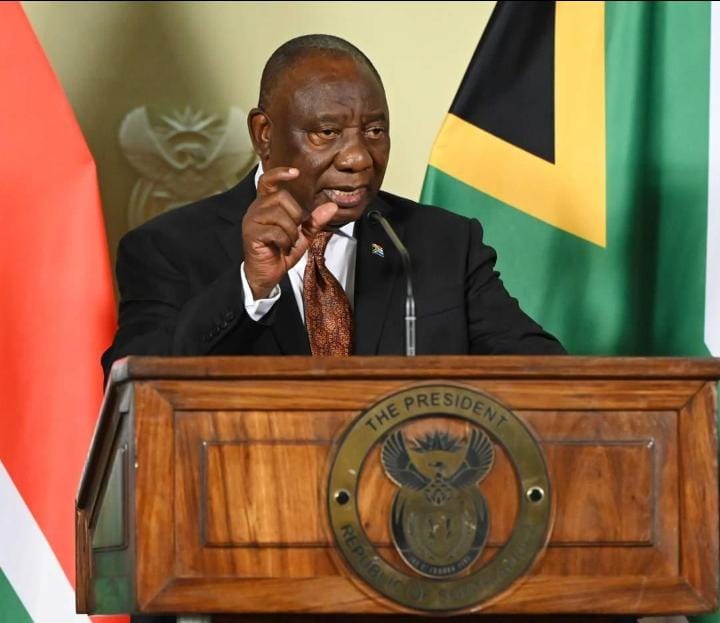
President Cyril Ramaphosa Addresses Nation Over Killings of Women
President Cyril Ramaphosa Addresses Nation Over Killings of Women
PRETORIA — President Cyril Ramaphosa has addressed the nation over the killings of women in Ekurhuleni, acknowledging the grief and anger surrounding the cases while announcing four immediate measures aimed at strengthening investigations, reducing forensic backlogs, improving public safety and addressing gender-based violence.
The address followed the discovery of another woman’s body in Springs, bringing the number of women’s bodies found in Ekurhuleni since July to 11.
President Cyril Ramaphosa said the killings had caused profound pain across the country and acknowledged that government’s efforts had not been enough to prevent women from being killed or to ensure their safety.
“The names of the victims are new, but the crime is not,” the President said, stressing that violence against women cannot become an accepted part of South African life.
A specialised multidisciplinary investigation into the Ekurhuleni killings has been elevated to national level, bringing together detectives, Crime Intelligence, forensic specialists, investigative psychologists and digital investigators.
Several arrests have already been made in connection with individual cases, while investigators continue to examine forensic evidence, including DNA, blood samples, clothing, cellphone information and other material. The CSIR is assisting with digital forensic investigations.
President Cyril Ramaphosa said police have not established that the killings were committed by a single perpetrator, despite concerns arising from the locations where some of the bodies were discovered. All possibilities remain under investigation.
The President also urged families and communities to report missing persons immediately, stressing that there is no requirement to wait 24 hours before reporting someone missing.
Four measures placed on government timetable
The first directive is a national case recovery operation focusing on unresolved murders, attempted murders, rapes and serious sexual offences involving women and children.
Police and Justice authorities have been given 60 days to conduct the audit. Within 90 days, priority and stalled cases must have recovery plans identifying outstanding actions, responsible officials and deadlines.
The second measure targets forensic backlogs.
The Minister of Police, the National Commissioner of Police and relevant forensic authorities must produce a funded plan within 60 days to reduce outstanding forensic work and establish turnaround standards for priority gender-based violence and femicide cases.
Evidence relating to the rape or murder of women and children is to receive urgent attention, with progress reported publicly every quarter.
The third measure requires every municipality to conduct a women's safety audit.
Authorities must identify risks such as broken streetlights, overgrown areas, abandoned buildings, unsafe transport routes, poorly secured parks and other public spaces where women may be vulnerable.
Urgent hazards must either be addressed or placed into funded implementation plans with clear completion dates, with communities able to track what has been identified and what action has followed.
The fourth measure focuses on alcohol-related violence and enforcement.
Provincial and municipal authorities have been instructed to strengthen enforcement against unlicensed liquor outlets and establishments operating outside their permitted trading hours.
A coordinated legislative and enforcement package aimed at reducing alcohol-related violence must also be submitted to Cabinet within 60 days.
President Cyril Ramaphosa stressed that alcohol does not cause gender-based violence and cannot excuse criminal behaviour, but said harmful alcohol use can aggravate interpersonal violence.
From policy to performance
President Cyril Ramaphosa pointed to existing interventions including strengthened specialised police units, Sexual Offences Courts, Thuthuzela Care Centres, forensic services, victim-friendly facilities and GBV desks at police stations.
He acknowledged, however, that institutions and policies only matter when they deliver assistance when victims need it.
A woman reporting abuse must be able to receive assistance from police. Protection orders must provide meaningful protection, forensic evidence must be processed without unreasonable delays, and cases must not collapse because of lost dockets, weak investigations or administrative failures.
The Inter-Ministerial Committee on Gender-Based Violence and Femicide and the National Council on Gender-Based Violence and Femicide will oversee implementation of the new measures.
A consolidated progress report is expected within 90 days, followed by quarterly public reporting.
Prevention moves to the centre of the response
President Cyril Ramaphosa said South Africa must address gender-based violence before it reaches the point of physical assault or murder.
He highlighted controlling behaviour, harassment, coercion and attitudes that treat women as inferior or subordinate as part of the wider environment in which violence can develop.
The President also cited research indicating that more than 60% of women murdered during 2021 and 2022 were killed by an intimate partner, placing particular emphasis on violence within interpersonal relationships.
He called for families, schools, universities, workplaces, sporting organisations, faith communities and other institutions to play a stronger role in prevention.
A message to men and boys
President Cyril Ramaphosa directed a specific appeal to South African men and boys, calling on them to challenge abusive and degrading behaviour among friends, colleagues and relatives.
He rejected attempts to place responsibility on victims and stressed that responsibility for violence belongs to the person who commits it.
The President also directed the Minister of Sport, Arts and Culture to strengthen the Moral Regeneration Movement's contribution towards changing attitudes, social norms and practices that contribute to violence against women.
The national response now moves into a period of defined deadlines and public reporting.
For families affected by the killings, the immediate priority remains justice. For government, the measures announced by President Cyril Ramaphosa establish a timetable against which implementation can be publicly monitored.
The President's closing message was directed at the country as a whole: ending gender-based violence requires sustained action from government, law enforcement, communities, institutions and men across South Africa.